

Europe | News
Serbia’s Student Movement Challenges Vučić’s 12-Year Political Dominance Ahead of Crucial Election
INTERNATIONAL POLITICS | SERBIA | 23 OCTOBER 2026
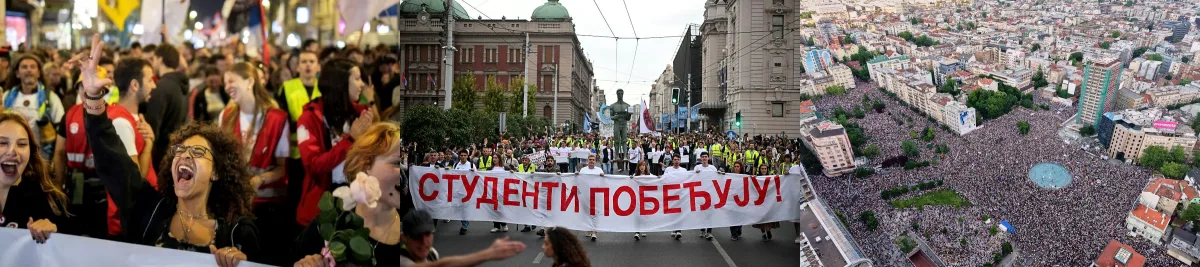
Serbia’s student-led protest movement is emerging as a significant challenge to President Aleksandar Vučić’s long-standing political dominance, as a wave of anti-government demonstrations develops into a nationwide campaign ahead of a crucial parliamentary election.
The movement, which began in November 2024 following a deadly railway station disaster, has attracted students, academics, farmers, professionals and other citizens demanding accountability, stronger institutions and action against alleged corruption.
According to the BBC’s report, the movement has evolved beyond campus demonstrations into an electoral challenge involving a broader coalition of citizens seeking political change.
How the protests began
The demonstrations were triggered by the collapse of a concrete canopy at the railway station in Novi Sad on 1 November 2024, which killed 16 people.
The disaster sparked public anger and questions about construction standards, oversight and possible corruption connected to infrastructure projects.
Students began organising demonstrations and university blockades, demanding the release of relevant documentation, accountability for those responsible and investigations into attacks on protesters.
The protests subsequently spread across Serbia, becoming a wider movement questioning the conduct of public institutions and the government’s response to the tragedy.
Why Vučić is facing a challenge
Vučić has occupied Serbia’s highest levels of government for more than a decade, serving as prime minister before becoming president in 2017. His Serbian Progressive Party (SNS) has been the dominant force in national politics.
The student movement has attracted attention partly because it has mobilised citizens beyond the traditional opposition parties. Rather than relying exclusively on established political figures, it has developed grassroots organising structures and a broader electoral platform.
Its campaign has focused on tackling corruption, reforming public institutions, reducing political influence over public broadcasting and holding officials accountable for alleged abuses.
Vučić and his party reject accusations of corruption and deny seeking to control the media.
From street protests to the ballot box
The movement’s transformation into an electoral force marks a major development in Serbia’s political contest.
Its Student List — Students Win campaign brings together candidates from different professional backgrounds, including academics, doctors, artists and farmers. The movement has sought to appeal to voters dissatisfied with the existing political establishment.
On Thursday, 22 October, large crowds gathered in Belgrade for its final campaign rally ahead of Sunday’s snap parliamentary election, scheduled for 25 October 2026. The Associated Press reported that the contest was expected to be closely fought between the student-backed list and the ruling party.
Concerns over electoral fairness
The election is taking place amid concerns about the fairness of the political environment.
Independent watchdogs and critics have raised issues involving media coverage, alleged pressure on activists, surveillance and reported violence against protesters. International observers are monitoring the electoral process.
The ruling party maintains its position in Serbia’s political system, while the student movement faces the challenge of translating large demonstrations and public support into votes and parliamentary representation.
The outcome remains uncertain, and the election could have significant implications for Serbia’s political institutions and its relationship with the European Union.
What happens next?
The Serbian election is an important test of whether a largely grassroots movement can convert sustained public mobilization into formal political power.
A strong electoral showing for the student-backed list could increase pressure for institutional reforms and greater accountability. However, the movement would still face the practical challenges of governing, maintaining unity and developing detailed positions on major domestic and foreign-policy questions.
For Vučić and the ruling SNS, the contest tests their ability to retain support after nearly two years of protests.
Factful24 takeaway: Serbia’s student movement demonstrates how a public tragedy can develop into a wider debate about corruption, institutional accountability and political representation. The election will test whether that mobilization can produce a corresponding shift at the ballot box.
Primary source: BBC News — Why a student protest movement is challenging 12 years of Vučić rule in Serbia. Additional reporting: Associated Press coverage of Serbia’s student movement and election.